
No Job is Too Big or Too Small!
China Top 10 Safety Harness Manufacturers for Buyers
Choosing a Safety Harness is a practical decision with serious consequences. A harness must fit the worker, suit the task, and work with compatible connectors and anchorage. The International Labour Organization’s 2023 report, A Call for Safer and Healthier Working Environments, estimates nearly three million work-related deaths and 395 million non-fatal work injuries worldwide each year. In the United States, the Bureau of Labor Statistics recorded 885 fatal workplace injuries involving falls, slips, and trips in 2023. These figures do not measure harness performance, but they show why fall-protection equipment deserves careful evaluation.
Details matter. Buyers comparing China’s leading manufacturers should look beyond catalog images and headline prices. Check product specifications, available test documentation, material traceability, inspection guidance, and the clarity of sizing options. Ask how the manufacturer verifies stitching and hardware, and whether production records can be reviewed. A neat sample is not proof of consistent production. That distinction can be easy to miss.
This guide introduces ten manufacturers for buyer research, not as a substitute for independent qualification. Compare each supplier against your work conditions, required standards, user training, and after-sales support. A harness alone cannot prevent every fall or injury. Selection also depends on the complete protection system and how workers use it. Some supplier information may be difficult to verify from public sources; treat that as a reason to ask better questions, not to assume the worst.
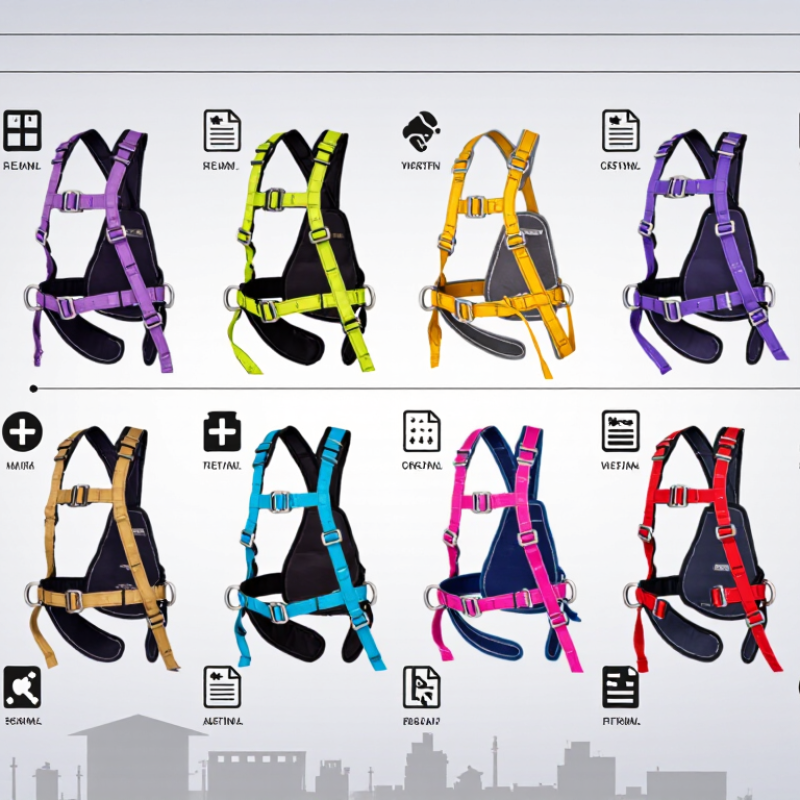
Safety Harness Basics: EN 361:2002 and Full-Body Fall-Arrest Equipment
EN 361:2002 sets requirements, test methods, and marking for full-body harnesses used in fall-arrest systems. A compliant harness is designed to distribute arrest forces across the body and keep the wearer supported after a fall. A harness alone does not stop a fall. It must connect to compatible equipment and a suitable anchorage.
Look for clearly identified fall-arrest attachment points, commonly marked with an “A,” and check that the harness fits the intended wearer. The dorsal attachment should sit between the shoulder blades, not near the neck or waist. Straps should lie flat and fit snugly without restricting movement. Buckles matter, too. A twisted leg strap can make a harness uncomfortable and may affect fit.
For buyers, review the product marking, instructions, size range, and documentation against the applicable requirements in your region. Before each use, inspect webbing, stitching, buckles, and labels for cuts, wear, corrosion, or missing information. Remove equipment from service if it has arrested a fall or shows damage, following the manufacturer’s guidance. Even careful visual checks cannot reveal every hidden weakness; that limitation deserves attention during training and equipment selection.
China Top 10 Safety Harness Manufacturers for Buyers - Safety Harness Basics: EN 361:2002 and Full-Body Fall-Arrest Equipment
Use these ten criteria to assess safety-harness manufacturers and products. The rows are buyer evaluation points, not a ranking of named companies.
| No. | Buyer Evaluation Dimension | Relevant Safety-Harness Fact | What to Verify with the Supplier |
|---|---|---|---|
| 1 | Applicable standard | EN 361:2002 specifies requirements, testing, marking, and information for full-body harnesses used as components of personal fall-protection systems. | Request documentation for the exact harness model and confirm that its scope and edition match the intended market and application. |
| 2 | Full-body construction | A full-body harness is designed to support the wearer across the body and distribute forces during a fall arrest; a waist belt alone is not a full-body harness. | Review the product design, intended use, and instructions; confirm the harness is not being offered as a substitute for a complete fall-protection system. |
| 3 | Fall-arrest attachment points | EN 361 fall-arrest attachment elements are identified by the letter “A.” Where two elements must be connected together to form an attachment point, they are marked “A/2.” | Check the physical markings and instructions to identify permitted attachment points and connection methods. |
| 4 | Standard-specific testing | EN 361 includes laboratory test requirements, including static-strength and dynamic-performance tests for harnesses and their attachment elements. | Ask for applicable test or conformity documentation tied to the product model; do not rely only on a generic statement that the product is “tested.” |
| 5 | Product identification and marking | Standard-compliant harnesses carry identification and information markings, including the relevant standard reference and identification of fall-arrest attachment elements. | Inspect a production sample and confirm markings are legible, durable, and consistent with the product documentation. |
| 6 | Fit and adjustment | A harness must be adjusted and worn in accordance with its instructions. Fit and adjustment affect whether the harness can function as intended. | Check the size range, adjustment method, fitting instructions, and whether the harness can be fitted correctly to the intended users. |
| 7 | Materials and components | Webbing, stitching, buckles, and attachment elements form part of the harness assembly; the complete product must meet applicable requirements. | Request component specifications and check that substitutions or design changes are controlled and supported by appropriate conformity evidence. |
| 8 | Instructions and compatibility | A harness is one component of a fall-protection system. System compatibility, use limitations, and connection instructions must be considered together. | Review instructions for compatible connectors and other system components, permitted uses, limitations, and user training information. |
| 9 | Inspection and retirement guidance | Inspection intervals, checks before use, care, storage, and retirement criteria should follow the manufacturer’s instructions and applicable workplace procedures. | Confirm that clear user instructions cover inspection, damage or fall-event response, cleaning, storage, and when the product must be removed from service. |
| 10 | Traceability and quality controls | Traceable product identification helps buyers connect a harness to its production and conformity records; quality-system claims do not replace product-specific compliance evidence. | Check batch or serial identification, change-control procedures, inspection records, and the supplier’s process for handling nonconforming products. |
Note: EN 361 addresses the full-body harness component. Selection and safe use also depend on the complete fall-protection system, the work environment, user training, and the applicable regulations.