
No Job is Too Big or Too Small!
How to Weld 304 Stainless Steel in 2026?
Welding 304 Stainless Steel requires control, cleanliness, and patience. This versatile alloy appears in food equipment, handrails, tanks, and architectural structures. Its clean surface can look forgiving, but heat quickly exposes weak technique. Excessive heat may cause distortion, discoloration, or reduced corrosion resistance around the weld.
This 2026 guide focuses on practical methods used by experienced fabricators. It explains joint preparation, filler selection, shielding gas, machine settings, and heat management. TIG welding often provides precise control on thin sheet and visible joints. MIG welding can improve productivity on thicker sections. Back purging may protect the inner surface when full penetration is required. Small details matter. A sharp tungsten, dry gas lines, and stainless-only brushes can prevent avoidable contamination.
The process is not identical for every workshop. Material thickness, joint design, position, and equipment all change the result. A setting that works on 1.5 mm sheet may overheat a narrow tube. Watch the puddle, not only the meter. Keep the arc stable, and allow short cooling pauses when distortion begins. Perfect color is not a complete quality test. That point is easy to overlook. Inspect the weld visually, remove heat tint appropriately, and confirm the finished joint meets the project specification. Qualified welders should follow an approved procedure and the relevant manufacturer or industry guidance. If results vary, record the settings and review the technique rather than guessing. Practical experience helps, but careful verification remains essential.
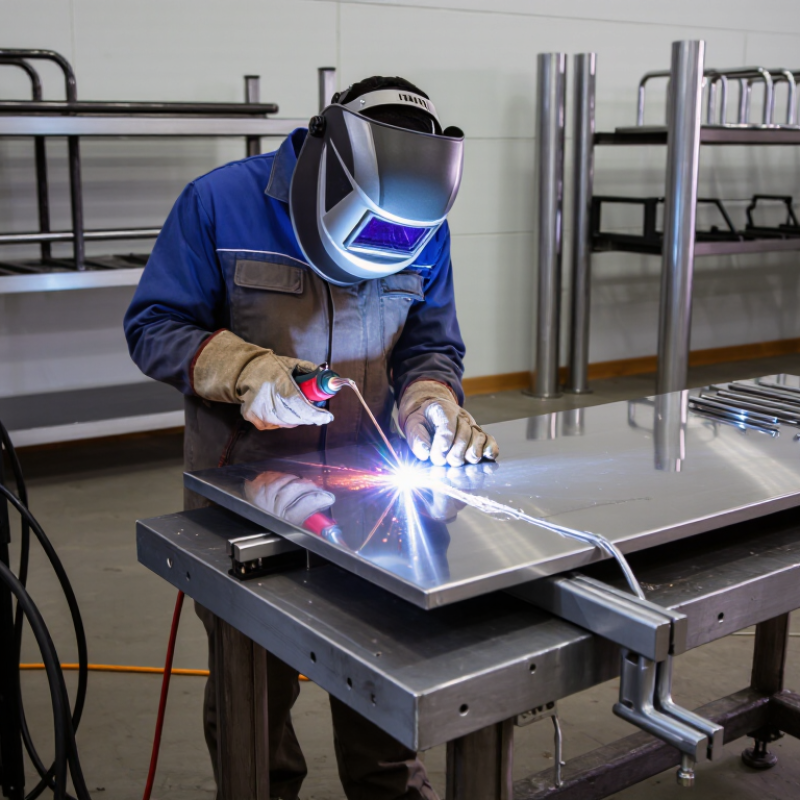
304 Stainless Steel: Composition, Properties, and Welding Considerations
How to Weld 304 Stainless Steel in 2026?
304 stainless steel usually contains about 18% chromium and 8% nickel. Its chromium content forms a protective oxide film against corrosion. Nickel improves toughness and shaping performance. Carbon content matters during welding. Standard 304 can become sensitized if held too long in the critical heat range. Corrosion may then appear near the weld. In practical fabrication, clean surfaces are essential. Use stainless-only brushes and tools. Even small carbon-steel particles can create rusty spots later.
Choose a qualified welding procedure for the joint thickness and service environment. TIG offers precise control for thin sheet and visible seams. MIG can improve productivity on larger assemblies. Use suitable filler metal, stable shielding gas, and strong gas coverage. Purge the root when the inside surface will contact corrosive fluids. Keep heat input controlled to reduce distortion and carbide precipitation. I still see attractive welds fail inspection because the back side was ignored. Appearance alone proves very little. Check penetration, discoloration, cracks, and surface contamination.
Tips: Clean before welding, not after. Keep the arc short. Avoid unnecessary weaving. Use tack welds to control movement. Let the joint cool naturally between passes. Do not quench it. Review the procedure when distortion seems excessive. Small adjustments often work better than simply increasing current. Personally, I would record gas flow, amperage, travel speed, and interpass temperature. That record makes troubleshooting less dependent on guesswork.
How to Weld 304 Stainless Steel in 2026? - 304 Stainless Steel: Composition, Properties, and Welding Considerations
| Category | Parameter | Typical Value or Recommendation | Welding Relevance |
|---|---|---|---|
| Material Composition | |||
| Chemical composition | Carbon (C) | Maximum 0.08 wt.% | Lower carbon limits carbide precipitation during welding; 304L is preferred when improved resistance to sensitization is required. |
| Chemical composition | Chromium (Cr) | 18.0–20.0 wt.% | Provides corrosion resistance by supporting formation of a protective chromium-oxide film. |
| Chemical composition | Nickel (Ni) | 8.0–10.5 wt.% | Stabilizes the austenitic structure and improves ductility and toughness. |
| Chemical composition | Manganese (Mn) | Maximum 2.00 wt.% | Supports deoxidation and influences weld-metal solidification behavior. |
| Chemical composition | Silicon (Si) | Maximum 1.00 wt.% | Acts as a deoxidizer; excessive levels can influence weld-metal fluidity and solidification. |
| Chemical composition | Phosphorus (P) | Maximum 0.045 wt.% | Kept low because elevated levels can reduce ductility and increase hot-cracking sensitivity. |
| Chemical composition | Sulfur (S) | Maximum 0.030 wt.% | Kept low to limit hot cracking and unfavorable weld-pool behavior. |
| Chemical composition | Nitrogen (N) | Maximum 0.10 wt.% | Can affect strength, phase balance, and corrosion performance in the weld area. |
| Chemical composition | Iron (Fe) | Balance | Base element of the alloy. |
| Physical and Mechanical Properties | |||
| Physical property | Material structure | Austenitic stainless steel | Generally non-magnetic in the annealed condition; cold working may increase magnetic response. |
| Physical property | Density | Approximately 8.00 g/cm³ | Useful for estimating component weight and heat-storage effects during fabrication. |
| Physical property | Melting range | Approximately 1,400–1,450°C | Requires controlled heat input to prevent excessive distortion and overheating. |
| Physical property | Thermal conductivity at about 100°C | Approximately 16.2 W/m·K | Lower than carbon steel, so heat remains concentrated near the weld and distortion can be significant. |
| Physical property | Coefficient of thermal expansion | Approximately 17.2 × 10⁻⁶/K near room temperature | Higher expansion increases the risk of distortion and residual stress compared with many carbon steels. |
| Mechanical property | Minimum tensile strength, annealed condition | 515 MPa | Representative minimum value for standard 304 product specifications; actual values depend on product form and standard. |
| Mechanical property | Minimum yield strength, 0.2% offset | 205 MPa | Representative minimum value for annealed material. |
| Mechanical property | Minimum elongation | 40% in 50 mm, commonly specified for annealed sheet and plate | Indicates high ductility, although welding and cold work can locally change mechanical behavior. |
| Mechanical property | Maximum hardness | Approximately 201 HB | Cold-worked material may be considerably harder; verify the supplied material condition before welding. |
| Welding Process Selection | |||
| GTAW / TIG | Best suited for | Thin sheet, root passes, precision work, and visible high-quality welds | Provides excellent control of arc, penetration, and shielding; use high-purity inert shielding gas and maintain clean gas coverage. |
| GMAW / MIG | Best suited for | Production welding and medium-to-thick sections | Use a stainless-compatible solid wire and a qualified shielding-gas mixture; excessive travel speed or heat can increase defects and distortion. |
| SMAW / Stick | Best suited for | Field work, repairs, and locations where gas shielding is difficult | Use moisture-controlled stainless electrodes and remove slag thoroughly between passes. |
| Resistance welding | Best suited for | Overlapped sheet assemblies and high-volume fabrication | Short welding cycles can limit distortion; electrode condition, pressure, current, and time must be controlled. |
| Laser welding | Best suited for | Low-distortion precision joints and automated production | Requires accurate fit-up, process qualification, and protection against oxidation of the weld and heat-affected zone. |
| Filler Metal and Joint Preparation | |||
| Matching filler option | 304 or 304L base material | Commonly use 308L-class stainless filler metal | The composition is designed for compatible corrosion resistance and weld-metal performance with 304-series stainless steel. |
| Higher-temperature service | Elevated-temperature application | Consider a qualified filler selected for the service temperature and design requirements | Filler selection should be based on service conditions, corrosion environment, code requirements, and metallurgical compatibility. |
| Surface preparation | Cleaning | Remove oil, paint, moisture, oxide, and other contaminants before welding | Use dedicated stainless-steel brushes and tools to avoid embedding carbon-steel particles that may cause surface rust. |
| Fit-up | Joint alignment | Maintain consistent root gap, alignment, and tack-weld spacing | Good fit-up reduces unnecessary weld volume, heat input, distortion, and burn-through risk. |
| Back purging | Root-side protection | Use inert-gas back purging for full-penetration joints where the root will be exposed to a corrosive service | Prevents heavy root oxidation, commonly called sugaring, which can reduce corrosion resistance and flow performance. |
| Heat Control and Welding Practice | |||
| Heat input | General control | Use the lowest qualified heat input that provides complete fusion and required penetration | Lower, controlled heat input helps limit distortion, grain growth, and loss of corrosion performance. |
| Interpass temperature | Recommended practice | Keep the workpiece cool between passes; a common practical limit is below approximately 150°C unless the qualified procedure specifies otherwise | Cooling between passes reduces cumulative heat and helps control distortion and sensitization risk. |
| Welding technique | Travel and bead placement | Use a steady travel speed, short arc where applicable, and stringer beads rather than excessive wide weaving | Reduces heat accumulation and improves control of bead shape and penetration. |
| Preheating | Normal requirement | Generally not required for clean 304 stainless steel at room temperature | Avoid unnecessary preheating because it can increase heat accumulation, distortion, and sensitization risk. |
| Post-weld cooling | Cooling method | Allow controlled air cooling unless the qualified procedure or material condition requires another method | Do not quench indiscriminately; thermal shock and distortion may affect the joint and surrounding component. |
| Corrosion, Defects, and Inspection | |||
| Sensitization | Temperature range of concern | Approximately 450–850°C during prolonged exposure | Chromium carbides may form at grain boundaries, reducing local corrosion resistance; use 304L or a qualified stabilized grade when appropriate. |
| Heat-affected zone | Typical concern | Loss of corrosion resistance, distortion, and changes in surface color | Control heat input, avoid unnecessary dwell time, and remove heat tint after welding when corrosion performance matters. |
| Heat tint removal | Cleaning methods | Use an approved mechanical, chemical, or electrochemical cleaning method suitable for the application | Removing oxidation restores a cleaner passive surface; follow applicable safety and environmental procedures for chemical treatments. |
| Common defects | Porosity, lack of fusion, undercut, distortion, and oxidation | Prevent through clean surfaces, correct shielding, stable parameters, proper fit-up, and adequate gas coverage | Inspect the weld using visual examination and, where required, appropriate nondestructive testing. |
| Final inspection | Verification | Check weld profile, discoloration, cracks, undercut, penetration, distortion, and cleanliness | Acceptance criteria should follow the applicable drawing, welding procedure, code, and service requirements. |
| Practical Selection Summary | |||
| Thin 304 sheet | Preferred approach | GTAW/TIG with precise current control and suitable backing or purging where required | Helps minimize burn-through, distortion, and visible surface defects. |
| Medium or thick 304 sections | Preferred approach | GMAW/MIG, GTAW/TIG root passes, or SMAW according to access and production requirements | Use a qualified welding procedure that defines filler metal, shielding, current, voltage, travel speed, and interpass temperature. |
| Corrosive service | Priority | Protect both the weld face and root from oxidation and contamination | Surface condition after welding can be as important as weld strength for maintaining stainless-steel corrosion resistance. |
| Code-controlled work | Priority | Qualify the procedure and welders according to the governing construction code and project specification | Material data alone does not replace procedure qualification, inspection requirements, or service-specific engineering review. |
Values shown are representative composition limits and minimum mechanical requirements commonly associated with annealed 304 stainless steel; exact requirements depend on the applicable material standard, product form, thickness, welding procedure, and service conditions.