No Job is Too Big or Too Small!

What Is PVC Injection Molding and How Does It Work?

PVC injection molding turns carefully prepared polyvinyl chloride compound into precise, repeatable plastic parts. The process begins with PVC pellets or powder, stabilizers, lubricants, and colorants. A heated barrel softens the compound before a rotating screw pushes it into a closed mold. Pressure fills narrow channels, corners, ribs, and textured surfaces. Cooling then locks the shape in place.

Douglas M. Bryce, a recognized injection-molding author and consultant, describes the process this way: “Injection molding combines material preparation, controlled pressure, and mold accuracy to create consistent parts.” That principle explains why pvc injection molding depends on more than heat and pressure. PVC can degrade when overheated or held too long inside the barrel. It may release corrosive by-products, too. Temperature control matters.

In practical production, technicians watch screw speed, injection pressure, cooling time, and mold temperature. A small setting change can leave sink marks, short shots, burn marks, or warped edges. Proper venting helps trapped air escape from the cavity. Clean material handling also protects surface quality. The process appears straightforward. It is not.

This guide examines what pvc injection molding is, how each stage works, and where common defects begin. It also considers tooling, machine selection, safety, and quality checks. Some explanations simplify real factory conditions. That limitation deserves attention. Every PVC formulation behaves differently, and reliable results require testing rather than assumptions.

What Is PVC Injection Molding and How Does It Work?

PVC Injection Molding: Definition, Purpose, and Material Properties

What Is PVC Injection Molding and How Does It Work?

PVC injection molding shapes heated polyvinyl chloride into precise parts. The process begins when solid pellets enter a heated barrel. A screw then melts and mixes the material before pushing it into a closed mold. After cooling, the mold opens, and ejector pins release the finished component.

PVC injection molding serves plumbing fittings, electrical conduits, seals, housings, and industrial profiles. Rigid PVC offers good stiffness, chemical resistance, and dimensional stability. Plasticized PVC remains softer and more flexible.

Its chlorine content improves fire resistance, but excessive heat can cause degradation and corrosive fumes. Process control matters.

Grand View Research’s PVC market report valued the global market at about USD 45.3 billion in 2022. It also projected a 3.3% compound annual growth rate from 2023 to 2030. These figures indicate continued demand, though market forecasts can change.

Tips: Keep melt temperatures within the supplier’s technical range. PVC dislikes prolonged heat exposure. Use suitable ventilation and corrosion-resistant tooling. Check moisture, screw speed, injection pressure, and residence time during trials. A practical mistake is changing several settings at once. That hides the real cause of defects. Inspect short shots, burn marks, weld lines, and warpage after every adjustment. No single setting works everywhere. Mold design, additives, wall thickness, and material grade all influence the result.

Core Components of a PVC Injection Molding System

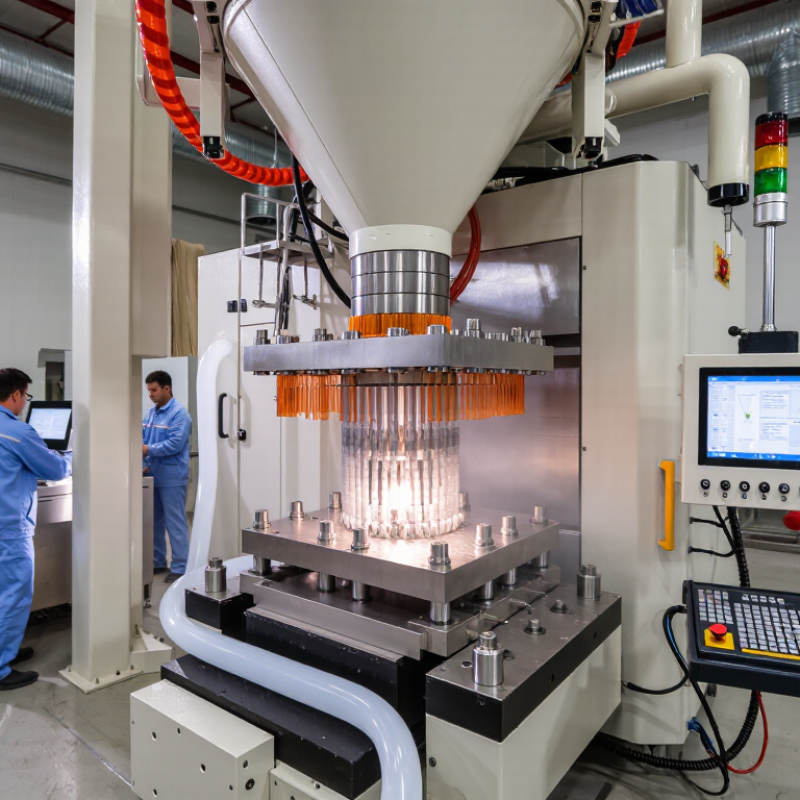
PVC injection molding relies on a coordinated system rather than a single machine. The hopper stores dry PVC material and feeds it into the heated barrel. Inside, a rotating screw conveys, melts, and mixes the compound. Its flight design influences pressure, color consistency, and residence time. Too much heat can degrade PVC and create dark streaks or corrosive fumes. Temperature control must be precise.

Heater bands warm the barrel, while sensors monitor each zone. The injection unit then pushes the melt through a nozzle into the mold cavity. The clamp unit holds the mold closed against injection pressure. A strong, accurately aligned mold protects part dimensions and reduces flash. Cooling channels remove heat before ejector pins release the molded component. Small channels can leave uneven shrinkage.

The control system connects these functions through pressure, temperature, screw speed, and timing settings. In practical production, operators check melt appearance, part weight, and cycle stability. A clean vent can prevent trapped air marks. PVC processing is less forgiving than many plastics, so ventilation and cleaning deserve constant attention. One setting is rarely perfect. Experienced teams may still adjust cooling time after inspecting actual parts, because wall thickness and mold geometry change the result.

Step-by-Step Process of PVC Injection Molding

PVC injection molding turns heated polyvinyl chloride into precise plastic parts. The process begins with material preparation. Operators check the PVC compound, remove contamination, and confirm its moisture condition. PVC usually needs careful drying and controlled handling. Small material changes can affect flow, color, and strength.

The mold is then installed and aligned inside the injection machine. Its cavities define the final part. The barrel heats the PVC gradually, while a screw mixes and moves the material forward. Temperature control matters because excessive heat can damage PVC. When the melt reaches the correct condition, the screw pushes it into the closed mold under pressure.

The mold stays closed during the holding stage. This pressure compensates for shrinkage as the part begins to cool. Cooling channels remove heat through the mold plates. After solidification, the mold opens, and ejector pins release the component. Operators inspect its surface, dimensions, edges, and possible burn marks.

The first shot is rarely perfect. That is normal. Technicians may adjust pressure, cooling time, or injection speed. However, random adjustments create new problems. Good practice records each change and checks the result carefully. Warping, short filling, and trapped air often reveal poor venting or an unstable process. A reliable setup balances material temperature, mold temperature, pressure, and cycle time. Small improvements can make production more consistent.

What Is PVC Injection Molding and How Does It Work?

Typical cycle-time distribution for a small-to-medium rigid PVC injection-molded part

PVC injection molding converts heated PVC compound into a finished part by closing the mold, injecting the melt, applying holding pressure, cooling the part, and then opening the mold for ejection. The example above uses a representative 18-second cycle: cooling normally takes the largest share because the polymer must solidify sufficiently before removal. Actual times vary with part thickness, mold design, PVC formulation, melt temperature, and machine settings.

Key Processing Conditions and Quality Control Factors

What Is PVC Injection Molding and How Does It Work?

PVC injection molding uses controlled heat and pressure to form plastic pellets into precise parts. The material is heated inside a barrel, injected into a mold, cooled, and ejected. It starts with heat. Yet PVC is sensitive to overheating, so temperature control must remain stable throughout the cycle.

Barrel temperatures should follow the material supplier’s processing window, not guesswork. Excessive heat can cause discoloration, burning, or corrosive decomposition products. Long residence times create similar risks. Moderate screw speed and back pressure help reduce unnecessary shear. Mold temperature also affects surface finish, shrinkage, and filling behavior. Cooling must be even, especially around thick sections. Small changes matter.

Quality control begins before production. Operators should inspect pellet condition, drying requirements, mold cleanliness, and equipment calibration. Each batch needs traceable records for temperature, injection pressure, holding pressure, cycle time, and cooling time. Visual checks can reveal silver streaks, weld lines, voids, flash, or color variation. Dimensional inspection confirms whether the part matches the drawing. Functional tests may expose weak gates or brittle areas.

A stable process is not always a perfect process. I have seen attractive parts fail after assembly because internal stress was ignored. That lesson is easy to miss. Sampling should continue during the run, not only at startup. When defects appear, changing several settings at once can hide the real cause. Controlled adjustments, retained samples, and calibrated gauges produce more reliable decisions.

Common Applications, Benefits, and Limitations of PVC Molding

What Is PVC Injection Molding and How Does It Work?

PVC injection molding melts measured PVC pellets and pushes them into a steel mold under controlled pressure. The mold defines the part’s shape, texture, and dimensions. After cooling, the machine opens, and ejector pins release the finished component. Processing temperatures require careful control because overheating can degrade PVC and release corrosive fumes.

Common Applications, Benefits, and Limitations of PVC Molding

Manufacturers use PVC molding for pipe fittings, electrical enclosures, seals, valves, medical components, and construction hardware. Its strong chemical resistance suits damp rooms, laboratories, and outdoor systems. PVC also offers stable insulation and relatively low material cost. PlasticsEurope reported 400.3 million tonnes of global plastics production in 2022, showing the scale of plastic processing demand. A Grand View Research report valued the global PVC market at about 56.1 billion dollars in 2023, although estimates vary by scope.

The process supports repeatable production and complex shapes. It can also reduce assembly work through integrated clips, ribs, or threads. However, PVC molding is not effortless. Poor drying, uneven cooling, or excessive shear may cause discoloration, warping, and brittle areas. Tooling costs can challenge small production runs. Recycling is possible, but additives and mixed formulations complicate sorting. In practice, designers should validate ventilation, wall thickness, and end-of-life handling early. I would not treat one material grade as universally suitable. Temperature, impact, flexibility, and regulatory requirements still demand testing.

What Is PVC Injection Molding and How Does It Work? - Common Applications, Benefits, and Limitations of PVC Molding

Data Dimension PVC Injection Molding Information Typical Values or Examples Practical Considerations
Process definition PVC injection molding is a manufacturing process in which heated polyvinyl chloride compound is injected under pressure into a mold, cooled, and ejected as a shaped part. Suitable for thermoplastic parts made in repeatable production cycles. The PVC formulation, mold design, processing temperature, and residence time must be carefully controlled because PVC can degrade when overheated.
Basic material Polyvinyl chloride is a chlorine-containing thermoplastic commonly supplied as a rigid or flexible compound with stabilizers, lubricants, pigments, impact modifiers, or plasticizers. Rigid PVC is used for structural or dimensional parts; flexible PVC is used for soft, resilient components. Material selection should match hardness, chemical exposure, temperature, electrical, and regulatory requirements.
How the process works The machine plasticizes the PVC compound, injects it into a closed mold, applies holding pressure, allows the part to cool, opens the mold, and ejects the finished component. The cycle normally includes feeding, plasticizing, injection, packing, cooling, mold opening, and ejection. Consistent metering, controlled shear, adequate venting, and short residence time help reduce defects and thermal degradation.
Indicative melt-processing temperature PVC is processed within a relatively narrow thermal window compared with many common thermoplastics. Approximately 160–210 °C, depending on the PVC type, formulation, equipment, and grade. The supplier’s technical data sheet should take priority. Excessive temperature or residence time may cause discoloration, odor, gas release, and loss of properties.
Mold-temperature range Mold temperature affects surface finish, filling behavior, dimensional stability, and cooling time. A commonly used starting range is approximately 20–50 °C, subject to formulation and part geometry. Higher mold temperatures may improve appearance but can increase cycle time and shrinkage variation.
Injection pressure Pressure is used to fill the cavity and compensate for material contraction during packing. An indicative range is approximately 70–140 MPa, depending on flow length, wall thickness, mold design, and compound viscosity. The correct setting should be established through process trials rather than treated as a universal specification.
Typical molding shrinkage PVC generally has relatively low molding shrinkage, although the actual value varies with formulation and processing conditions. Approximately 0.2–0.6% for many rigid PVC applications. Tooling compensation should consider flow direction, wall thickness, packing pressure, cooling uniformity, and part geometry.
Moisture preparation PVC is not generally treated as a strongly hygroscopic engineering plastic, but pellets or compound may still collect surface moisture during storage. Drying requirements depend on the specific compound and storage conditions. Follow the material supplier’s drying instructions. Unnecessary high-temperature drying can damage the material.
Mold design requirements The mold should support balanced filling, controlled cooling, effective venting, and safe ejection. Uniform wall sections, smooth transitions, rounded corners, suitable draft angles, and correctly sized gates are commonly recommended. Poor venting or sharp flow restrictions can cause burns, weld-line weakness, incomplete filling, or surface defects.
Equipment considerations PVC requires equipment and process controls that limit contamination, excessive shear, and prolonged exposure to heat. A corrosion-resistant material path, appropriate screw design, accurate temperature control, and effective ventilation are useful features. PVC should not be left hot in the barrel for extended periods. Purging and cleaning procedures are important during material changes or shutdowns.
Common rigid PVC applications Rigid PVC is selected for parts requiring dimensional stability, chemical resistance, and electrical insulation. Pipe fittings, valve components, electrical conduit accessories, junction-box parts, protective covers, and hardware components. Applications involving pressure, potable water, or fire performance require the relevant product and regulatory approvals.
Common flexible PVC applications Flexible PVC provides softness, resilience, and resistance to moisture for selected applications. Seals, grommets, flexible caps, cable jackets, grips, tubing components, mats, and protective sleeves. Plasticizer migration, extraction, odor, and compatibility with oils or chemicals should be evaluated for the intended service environment.
Production-volume suitability Injection molding is most economical when tooling costs can be distributed across repeated production. Well suited to medium- and high-volume production of identical or family-of-parts components. For prototypes or very small batches, machining, 3D printing, or other forming methods may require less initial investment.
Main benefits PVC molding can produce complex shapes with repeatable dimensions and integrated features. Good chemical and moisture resistance, electrical insulation, broad hardness options, colorability, and efficient automated production. The benefit level depends on the compound and should be verified against real operating conditions.
Material cost considerations PVC is widely available and can be cost-effective compared with some specialty thermoplastics. Overall part cost includes resin, additives, mold tooling, machine time, labor, quality control, and scrap management. A low material price does not eliminate the need for suitable ventilation, process controls, and compliant waste handling.
Thermal limitations PVC has limited thermal stability during processing and service compared with many high-temperature engineering plastics. Long exposure to elevated temperatures can cause discoloration, embrittlement, deformation, or degradation. Use the compound’s continuous-use and short-term temperature ratings rather than relying only on general PVC properties.
Chemical and environmental limitations PVC resists many aqueous chemicals but is not universally compatible with every solvent, fuel, oil, or plasticizer-extracting environment. Compatibility varies with rigid or flexible formulation, concentration, temperature, and exposure duration. Perform application-specific immersion, stress-cracking, aging, and dimensional tests when chemical exposure is important.
Health, safety, and ventilation Overheating PVC can release corrosive and irritating decomposition products, including hydrogen chloride. Temperature alarms, local exhaust ventilation, suitable personal protective equipment, and documented shutdown procedures are important controls. Never intentionally process visibly degraded material. Workplace controls must comply with applicable safety regulations.
Recycling and end-of-life PVC can be mechanically recycled when waste streams are clean, identified, and compatible. Production sprues and runners may be reground and blended where the compound specification permits. Mixed formulations, additives, contamination, and repeated heat history can reduce recyclate consistency. Local recycling rules should be followed.
Quality-control checks Quality control verifies that molded parts meet dimensional, visual, mechanical, and functional requirements. Typical checks include dimensions, weight, color, flash, sink marks, short shots, weld lines, hardness, leakage, and assembly fit. Process capability studies and documented inspection criteria help maintain consistency across production batches.
Common molding defects Typical defects include short shots, flash, burns, discoloration, weld lines, warpage, sink marks, voids, and dimensional variation. Possible causes include incorrect temperature, excessive shear, poor venting, unbalanced filling, inadequate packing, or uneven cooling. Troubleshooting should change one controlled variable at a time and include inspection of both material and mold conditions.

Note: Processing ranges are indicative starting points only. Exact values depend on the PVC formulation, equipment, mold design, part geometry, and the material supplier’s technical data.