
No Job is Too Big or Too Small!

What Are the Top Types of Lead Radial Capacitors in 2026?

Lead Radial Capacitors remain practical components in power supplies, audio equipment, and industrial control boards. Their wire leads pass through a circuit board, while the cylindrical body sits above it. That simple form can make hand assembly and replacement easier. Yet choosing the right Lead Radial Capacitor takes more than matching capacitance.

This guide examines the leading types designers may encounter in 2026, including aluminum electrolytic, solid polymer, film, and ceramic options. Each has trade-offs. An aluminum electrolytic part can offer substantial capacitance in a compact footprint, but its service life depends partly on temperature and ripple current. Polymer types often provide lower equivalent series resistance, though voltage ratings and cost deserve close attention. Film and ceramic parts suit different demands, and neither is a universal substitute. Small details matter.

A useful comparison starts with the circuit’s voltage, capacitance, ripple current, operating temperature, expected lifetime, and available board space. Check the datasheet, not just the product title. Two parts with the same capacitance can behave differently under heat or high-frequency load. Even this checklist has limits: real performance depends on the full circuit and mounting conditions.

A named expert quotation cannot be responsibly attributed without a verifiable source. Rather than invent one, this introduction focuses on practical selection factors. The sections ahead compare the main types, explain where each fits, and flag common trade-offs that are easy to miss.
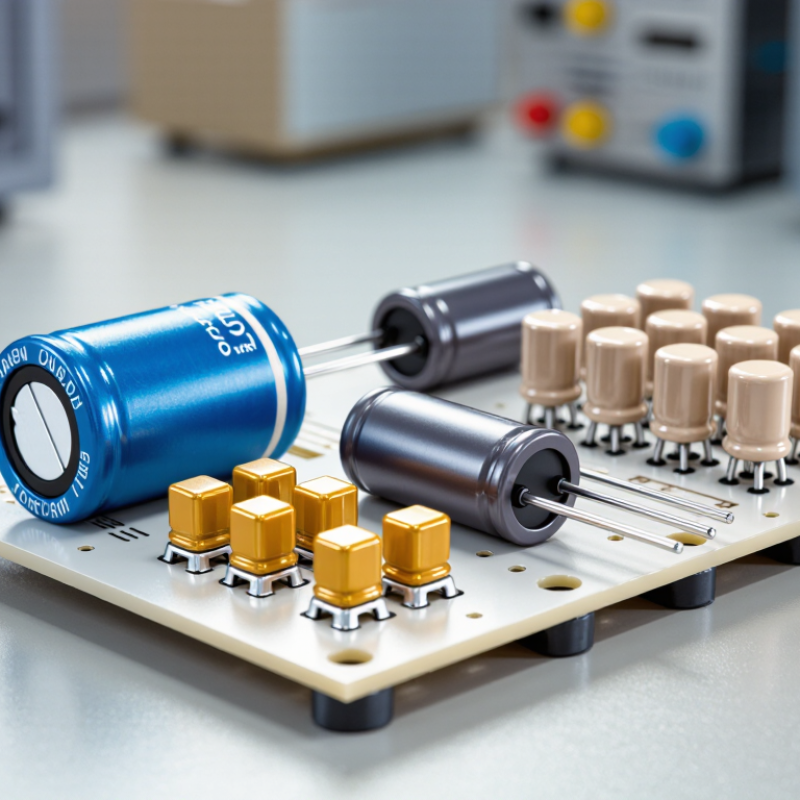
What Are the Top Types of Lead Radial Capacitors in 2026?

What Are Lead Radial Capacitors and How Are They Constructed?

Lead radial capacitors have two wire terminals exiting from the same end of a compact body. The leads pass through a circuit board, then are soldered in place. Their shape suits crowded boards and through-hole assembly. Construction depends on the capacitor family. In an aluminum electrolytic type, etched aluminum foil forms the anode, a thin oxide layer acts as the dielectric, and electrolyte helps form the cathode. A separator keeps the layers apart. The wound element sits inside a metal can, sealed with a rubber bung. Polarity markings matter. Reversing them can cause overheating or failure.

Radial film and ceramic capacitors use different internal structures. Film types wind or stack dielectric film with metal electrodes; ceramic types build alternating ceramic and electrode layers. Their molded or coated bodies protect those elements, while lead spacing sets board compatibility. The IEC 60384 series defines test and performance requirements for several fixed-capacitor families, helping engineers compare rated voltage, temperature range, and endurance. Grand View Research’s 2024 capacitor-market report estimated a 2023 global market of about US$22.53 billion, with a 4.5% forecast CAGR for 2024–2030. That broad figure is not specific to radial parts. The schematic looks tidy; real choices still depend on ripple current, heat, and available space.

Which Radial Aluminum Electrolytic Capacitors Are Common in 2026?

In 2026, common radial aluminum electrolytic capacitors include general-purpose, low-impedance, long-life, and high-temperature types.
Their cylindrical bodies sit upright on a circuit board, with two leads passing through it. General-purpose parts often suit power-supply filtering and everyday decoupling. Low-impedance versions handle heavier ripple current, such as near switching power stages. Long-life and high-temperature types are useful in warm enclosures, where drying electrolyte can shorten service life.
Small parts, big trade-offs.

Grand View Research’s aluminum electrolytic capacitor market analysis estimated a global market value of about $6.02 billion in 2022 and forecast 5.5% annual growth from 2023 to 2030. That figure covers the broader capacitor market, not radial types alone. Market estimates vary.

For an actual design, check capacitance, rated voltage, ripple-current rating, case size, and endurance conditions in the component’s datasheet. IEC 60384-4 provides a framework for fixed aluminum electrolytic capacitors, but it does not choose the right part for a particular board. A high-temperature rating can help, yet it is not a cure for poor airflow or excessive ripple.
That distinction is easy to miss.

How Do Radial Ceramic, Film, and Tantalum Capacitors Differ?

Radial ceramic, film, and tantalum capacitors differ in dielectric, size, and circuit behavior. Fortune Business Insights’ 2024 Capacitor Market report valued the global market at USD 23.36 billion in 2023, reflecting broad demand across electronic equipment. That figure describes the whole market, not radial parts alone.

Ceramic parts are compact and useful for general bypassing, but their capacitance can shift with temperature and applied voltage, especially with some high-capacitance dielectrics. Film capacitors are usually larger; they offer stable performance and suit timing, filtering, and pulse circuits. Radial tantalum parts pack substantial capacitance into a small body, but they are polarized and need careful voltage and surge margins.

Size matters. IEC 60384 standards classify fixed capacitors by dielectric and application, a useful reference when comparing datasheets. Still, a neat category label cannot replace checking the actual operating conditions.

Tips: Match capacitance, voltage, temperature range, and ripple current to the circuit. Check polarity before fitting tantalum parts. For ceramic choices, confirm the effective capacitance under real voltage; the printed value can be optimistic. A little extra board space may be worth it.

What Applications Suit Each Type of Lead Radial Capacitor?

Radial-leaded capacitors suit different jobs, not just different board layouts. Aluminum electrolytics are common in power supplies, where they smooth low-frequency ripple after rectification. Check ripple-current and temperature ratings; a small can may run hot. Ceramic types work well for local bypassing and high-frequency noise near a controller. Their capacitance can shift with voltage and temperature. Film types suit pulse, timing, and AC circuits that need stable characteristics. They are often larger. That trade-off matters in a crowded enclosure.

Vehicle electronics make these distinctions practical. The IEA’s Global EV Outlook 2024 reports nearly 14 million electric-car sales in 2023, about 18% of global car sales. That growth expands the need for power conversion and control, but it does not prove demand for any specific capacitor type. Film capacitors can handle pulse and DC-link duties; electrolytics can provide bulk smoothing. Use the circuit’s voltage, ripple, vibration, and temperature limits to narrow the choice.

For compact, low-voltage control boards, radial tantalum parts can offer stable capacitance in limited space, but they are polarized and need careful surge protection. Radial supercapacitors fit brief backup or memory-retention tasks, not ordinary high-frequency bypassing. The IEA’s Electricity 2024 report estimates data centres, AI, and cryptocurrency used about 460 TWh in 2022. That rising power load makes supply efficiency and thermal design important. Datasheet values help, but real board temperature and waveform can tell a less tidy story.

How to Choose a Lead Radial Capacitor for a 2026 Design?

How to Choose a Lead Radial Capacitor for a 2026 Design?

Start with the circuit, not the package. For a power-supply input, compare capacitance, ripple-current rating, ESR, and lifetime at the actual operating temperature. An aluminum electrolytic may offer high capacitance in a compact footprint, but heat and ripple current can shorten its service life. For timing or signal paths, a film capacitor may provide better stability, though it can take more board space. Check the full temperature range. A room-temperature test is not enough.

Voltage needs headroom. Compare the capacitor’s rated voltage with the circuit’s steady voltage and expected surges, then confirm polarity where relevant. Also check lead spacing and body dimensions against the PCB and nearby components. Fortune Business Insights’ 2024 capacitor-market report estimated the global market at USD 22.53 billion in 2023, reflecting broad demand across electronic applications; that figure does not identify which type suits a specific circuit. Use component data sheets and applicable IEC 60384 requirements to verify endurance, safety class, and test conditions. Small details matter. One easy-to-miss trade-off is choosing a higher-capacitance part that fits electrically but blocks airflow or sits too close to a hot component. I would recheck that layout before release.

What Are the Top Types of Lead Radial Capacitors in 2026? How to Choose One for Your Design

Capacitor type Typical capacitance and voltage range Polarity Key strengths Design considerations Common applications Best fit when...
Aluminum electrolytic About 0.1 µF to tens of thousands of µF; commonly a few volts to several hundred volts Usually polarized High capacitance for its size; widely available; often economical for bulk energy storage Check ripple-current rating, lifetime at operating temperature, ESR, leakage current, and polarity. Capacitance and lifetime can change substantially with temperature and use conditions. Power-supply smoothing, low-frequency filtering, and bulk DC-link storage You need relatively high capacitance and can accommodate a polarized component with finite service life.
Conductive-polymer aluminum electrolytic Commonly several µF to a few thousand µF; voltage ratings are generally lower than those of many conventional aluminum electrolytics Usually polarized Often offers low ESR and strong ripple-current capability compared with conventional aluminum electrolytics of similar size Check surge and reverse-voltage limits, leakage current, temperature rating, and the exact manufacturer's lifetime conditions. Available voltage and capacitance combinations vary by series. Low-voltage switching regulators, processor power rails, and compact power supplies Low ESR and ripple handling matter more than very high voltage capability.
Multilayer ceramic (radial-leaded) From pF values to tens of µF; voltage ratings range from low voltage to several kilovolts, depending on dielectric and size Non-polarized Low ESR and ESL; useful for high-frequency bypassing. C0G/NP0 types provide stable capacitance, while X7R types offer higher capacitance in a given size. For high-capacitance Class 2 ceramics such as X7R, account for capacitance loss under DC bias, temperature, and aging. Confirm the effective capacitance at the actual operating voltage. Decoupling, signal coupling, timing, and high-voltage applications where an appropriate part is available You need a non-polarized component, especially for high-frequency use or stable capacitance with a C0G/NP0 dielectric.
Film: polyester (PET) Commonly nF values to tens of µF; voltage ratings range from low voltage to several hundred volts or more Non-polarized Good general-purpose stability, low leakage, and useful pulse performance for many signal and power applications Check dissipation factor, temperature range, pulse limits, and physical size. Capacitance and voltage availability depend on case size and construction. Signal coupling, timing, filtering, and general-purpose AC or DC circuits You want a versatile non-polarized capacitor with stable performance and moderate cost.
Film: polypropylene (PP) Commonly nF values to tens of µF; available in a broad range of voltage ratings, including high-voltage options Non-polarized Low dielectric loss, good stability, and strong suitability for many pulse and AC applications Often larger than a polyester capacitor at the same capacitance and voltage. Verify AC current, pulse rating, and operating temperature against the specific datasheet. Pulse circuits, resonant circuits, motor-run circuits, and low-loss filtering Low loss, stability, or pulse performance is a priority and board space allows for the part size.
Tantalum electrolytic Typically sub-µF values to hundreds of µF; commonly used at low to moderate voltage ratings Polarized High capacitance per volume and relatively stable capacitance across temperature compared with many aluminum electrolytics Observe polarity and derating guidance. Check surge current, ripple, ESR, and failure-mode requirements; do not select by capacitance alone. Compact power-rail filtering and embedded electronics Board area is constrained and a polarized, derated component meets the circuit's reliability requirements.
Electric double-layer capacitor (supercapacitor) Typically fractions of a farad to tens of farads per cell; cell voltage is usually only a few volts Usually polarized Very high capacitance for short-term energy storage; can support frequent charge and discharge cycles Check leakage current, ESR, voltage balance for series-connected cells, backup duration, and temperature-dependent life. It is not a direct substitute for a battery or an ordinary smoothing capacitor. Memory backup, short-duration hold-up, and energy buffering You need brief energy storage or hold-up at low voltage rather than conventional filtering alone.

Selection note: These are representative, technology-level ranges—not guaranteed specifications for every radial-leaded part. For a 2026 design, verify the current datasheet for the exact component, including effective capacitance, voltage derating, ripple current, ESR, temperature range, lifetime, dimensions, lead spacing, and applicable safety approvals.