
No Job is Too Big or Too Small!
How to Choose the Right Plastic Angle for Global Sourcing?
Choosing the right plastic angle for global sourcing is not simply a matter of finding the lowest quotation. The correct choice depends on load, temperature, moisture, UV exposure, wall thickness, and installation method. A warehouse corner may need impact resistance, while a lightweight display frame may prioritize appearance and easy drilling. Small details matter. A two-millimeter tolerance can change the entire result.
Professor Tim Osswald, a respected polymer-processing specialist, often emphasizes that material selection must balance performance, processability, and cost. That principle should guide every plastic angle comparison. Buyers should request the resin type, reinforcement details, dimensional tolerances, surface finish, and test conditions. A supplier’s phrase such as “high strength” is incomplete without numbers. Ask for tensile data, impact results, temperature limits, and batch consistency. Do not guess.
Global sourcing adds practical concerns. Confirm packaging quality before shipment. A good plastic angle can arrive warped after poor stacking or prolonged heat exposure. Check whether the supplier can maintain the same color, profile, and hole position across repeated orders. Certifications may matter for specific applications, but they should match the destination market and intended use. Over-certifying can waste money; under-checking can create serious problems.
Samples are useful, but one sample is not proof. Production conditions may differ. Even experienced buyers sometimes trust attractive surfaces too quickly. That is the trap. A stronger sourcing process combines drawings, physical testing, supplier audits, and honest cost analysis. This guide explains how to compare plastic angle options with practical judgment, while recognizing that the “perfect” material rarely exists.
Understanding Plastic Angles and Their Common Applications
How to Choose the Right Plastic Angle for Global Sourcing?
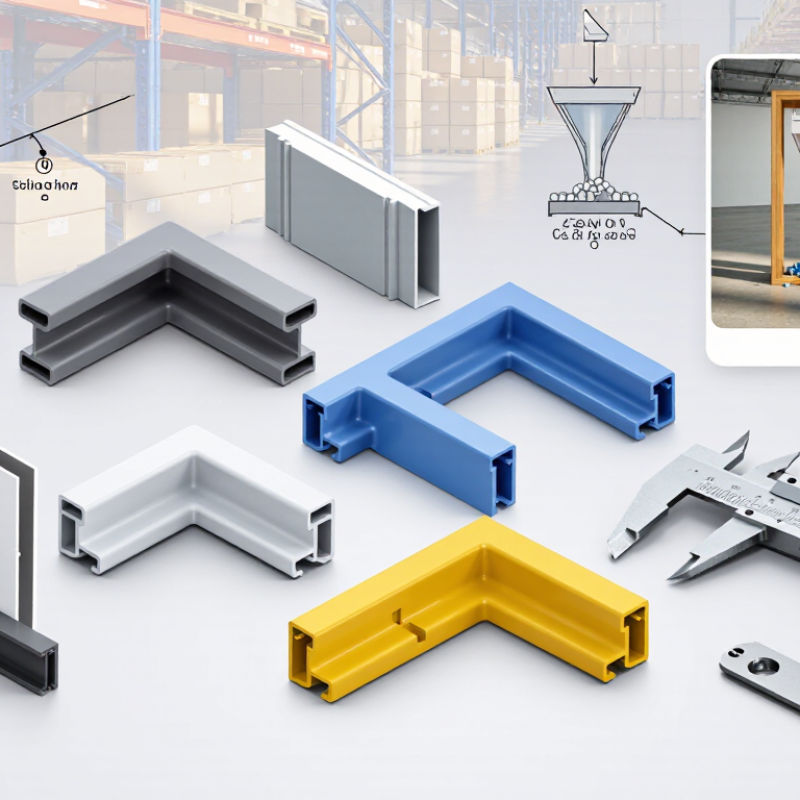
A plastic angle is an L-shaped profile used to protect, join, or reinforce edges. It may look simple, but its performance depends on material, thickness, and application. PVC angles suit indoor trim, cable protection, and light-duty assembly. Polypropylene handles moisture well and works around containers or washdown areas. For outdoor use, a UV-stabilized material is usually safer. Check the working temperature, impact strength, and chemical exposure before requesting quotations.
Applications often reveal the correct design. A thin angle can cover a sharp cabinet edge, while a thicker section may support panels during transport. Measure both legs, wall thickness, hole spacing, and cut length carefully. Small dimensional errors can create visible gaps during installation. Global sourcing also requires consistent drawings, inspection samples, and clear tolerance requirements. A supplier may quote the same profile, yet use a different grade or forming method. That difference matters.
Tips: Request a sample before approving bulk production. Test it in the real environment, not only on a desk. Compare flexibility, surface finish, and fit. Ask for material data and inspection records. Avoid choosing only by the lowest price. I have found that simple profiles deserve extra checking because their low unit cost can hide costly installation problems. Some designs still need revision after testing. That is normal, and worth acknowledging.
How to Choose the Right Plastic Angle for Global Sourcing? - Understanding Plastic Angles and Their Common Applications
| Plastic Angle Type | Typical Material | Representative Size Range | Key Characteristics | Common Applications | Main Selection Considerations |
|---|---|---|---|---|---|
| Rigid L-Profile | PVC, ABS, HDPE, polypropylene, or polycarbonate | Legs approximately 10–100 mm; wall thickness approximately 1–6 mm | Lightweight, corrosion-resistant, easy to cut and drill; stiffness depends strongly on wall thickness and profile dimensions | Edge protection, frame construction, shelving, cabinet interiors, packaging supports, and light-duty fabrication | Confirm load, temperature, UV exposure, chemical contact, and required dimensional tolerance |
| Flexible Angle Trim | Flexible PVC, TPE, or TPU | Legs approximately 10–50 mm; flexible wall or gripping section commonly 1–4 mm | Conforms to irregular edges, cushions contact surfaces, and can absorb minor movement or vibration | Furniture edges, sheet-metal protection, display fixtures, glass and panel edging, and cable or hose protection | Measure the actual edge thickness; evaluate grip force, bend radius, compression set, and long-term flexibility |
| Equal-Leg Angle | PVC, ABS, polypropylene, or polycarbonate | Common leg proportions include 20 × 20 mm, 30 × 30 mm, 50 × 50 mm, and 75 × 75 mm | Provides balanced coverage on both sides of a corner and simplifies symmetrical assembly | Box construction, partition frames, corner guards, equipment enclosures, and general joining work | Choose leg length based on overlap area and wall thickness based on expected bending or impact loads |
| Unequal-Leg Angle | PVC, HDPE, polypropylene, or polycarbonate | Typical combinations include 20 × 40 mm, 25 × 50 mm, and 30 × 60 mm | Offers different coverage on each surface and can accommodate offset joints or uneven panel thicknesses | Panel joining, wall and floor transitions, protective flanges, and customized enclosure assemblies | Select each leg independently according to the required overlap, clearance, and fastening position |
| Heavy-Duty Structural Angle | Glass-filled nylon, reinforced polycarbonate, or high-strength engineering thermoplastic | Legs commonly 25–100 mm; wall thickness approximately 3–10 mm | Higher stiffness and strength than general-purpose profiles; may withstand repeated mechanical loading when properly designed | Machine guards, equipment frames, industrial supports, transport fixtures, and structural brackets with moderate loads | Request tensile, flexural, impact, creep, and temperature data; consider fastener pull-out and long-term deflection |
| Transparent Angle | Clear polycarbonate or acrylic | Legs approximately 15–75 mm; wall thickness approximately 1–5 mm | Allows visibility through or around the corner; polycarbonate generally offers higher impact resistance than acrylic | Display cases, signage, protective glazing edges, lighting assemblies, and transparent partitions | Compare optical clarity, impact resistance, UV stability, scratch resistance, and cleaning-chemical compatibility |
| UV-Stabilized Outdoor Angle | UV-stabilized PVC, HDPE, ASA, or polycarbonate | Legs approximately 20–100 mm; wall thickness approximately 2–8 mm | Designed to retain appearance and performance more effectively during outdoor exposure than non-stabilized grades | Outdoor enclosures, greenhouse components, exterior signage, fencing details, and construction trim | Verify accelerated-weathering results, color-change limits, climate conditions, moisture exposure, and expected service life |
| High-Temperature Angle | High-temperature polycarbonate, PEEK, PPS, or specialized engineering thermoplastics | Commonly customized; profile size is selected according to thermal and mechanical requirements | Maintains useful stiffness and dimensional stability at elevated temperatures better than commodity plastics | Electrical equipment, industrial ovens, engine compartments, processing machinery, and hot-air duct details | Use continuous-use temperature data, thermal expansion values, flame rating needs, and chemical-resistance information |
Related Posts
-
Exploring the Impact of Plastic Angle Innovation at the 138th Canton Fair in 2025
-
Top Uses of Plastic Angle in Construction and Home Improvement Projects
-

What is a Plastic Angle and Its Common Applications?
-

Top Strategies for Optimizing Plastic Angle Products in Your Business
-

Top Benefits of PVC Injection Molding for Modern Manufacturing?
-

Why Are Plastic Profiles the Best Choice for Your Construction Projects